
Hannah's Theory
Written on Tuesday 20 October 2026, after Episode 6. The silos on the home page keep the score up to date.
Hannah Furrow came out of the game with notes. Towed as a Traitor on day 6, she sat down on the aftershow, The Celebrity Traitors: Uncloaked, and said she had studied every earlier series before going in, using "the same technique that Alan Turing used to crack the Enigma machine". She had three giveaways for spotting a Traitor. I've tested them on every slate of this series so far, along with every other rule I could find, and then on fourteen of the series she learned them from.
Updated on 22 October. This is the real test. Hannah learned her rules from the earlier series, so her rules are now weighed on 14 of them, with the method fixed in writing before any of them was scored, and applied unchanged to this one. Earlier versions, on 20 and 21 October, weighed the rules on this series alone, and two of them had counting errors. Hannah's own slates are now left out of rule one's counts: she wrote the rules and played knowing them, so her votes can't fairly test them.
What Turing did
To read an Enigma message you needed that day's machine settings, and the settings changed every day. Turing didn't wait for one decisive clue, because there wasn't one. He made a guess at part of the settings, then scored each clue in the messages by how much more likely it was if the guess was right than if it was wrong. A clue ten times as likely was worth one ban, a unit he named after Banbury, the town where the codebreakers' sheets of paper were printed. The scores add up. One clue is a hunch. Enough of them, all pointing the same way, is something you can act on.
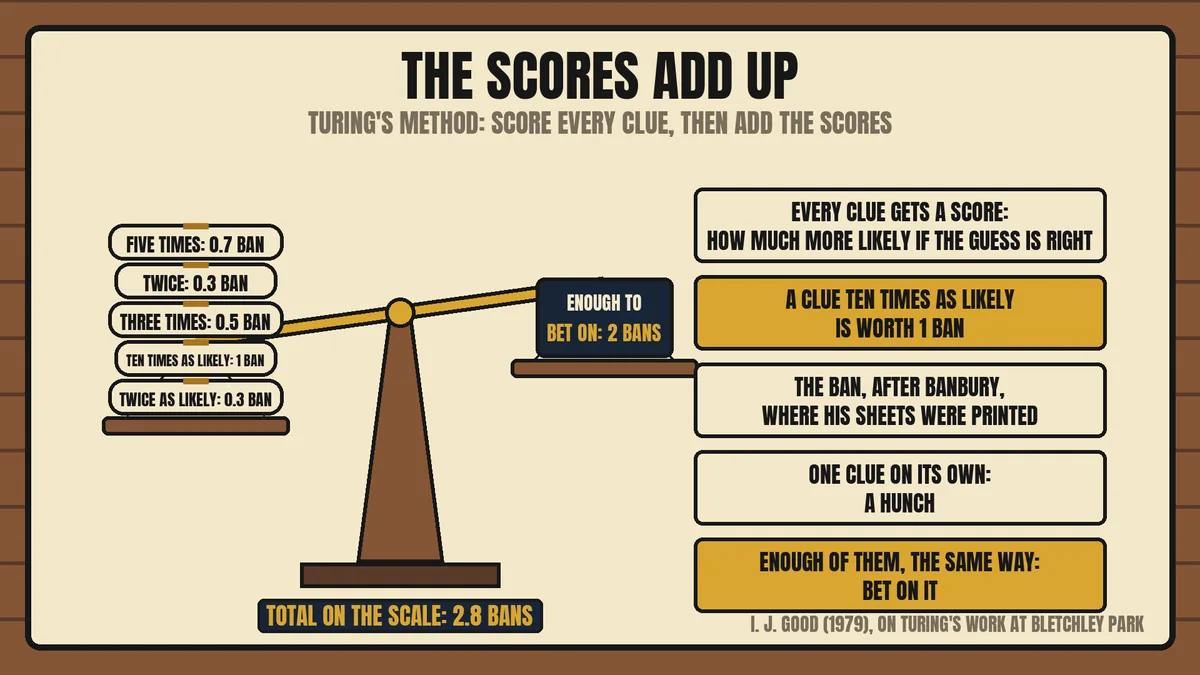
Hannah's rules work the same way. None of them catches a Traitor on its own. The question is whether each is worth something, and whether the amounts add.
How I tested them
There have been five Round Bales so far, on days 3 to 7, and five Traitors: Haya Jama and Richard E Grain from the start, James Haycaster recruited on night 2, Hannah herself on night 3 and King Kubota on night 6. Two kinds of slate are left out of the counts. The tractor the room was voting for can't vote for themselves, so their slate tells you nothing. And Hannah's own slates are left out: she wrote these rules and played knowing them, so her votes can't fairly test them, whichever way she used them. Her slates still count when working out which name was the room's and which slate was lone; she just isn't scored as a voter. That leaves 77 seats, and Traitors filled 11 of them: a baseline of 14%, about one in seven. A rule that points at a Traitor more often than that is telling you something.
Every sample here is small, and a single tractor can move a percentage by ten points, so treat each number as a lead.
Rule one: the burn vote
Hannah said a Traitor casts a burn vote in the first three episodes, and named Haycaster and Haya as examples. Haycaster's was the only slate for Michael Machine on day 4. Haya's, the same night, was one of four for Jerry Haul. So a burn vote has to mean a vote away from the room, not necessarily a vote on your own.
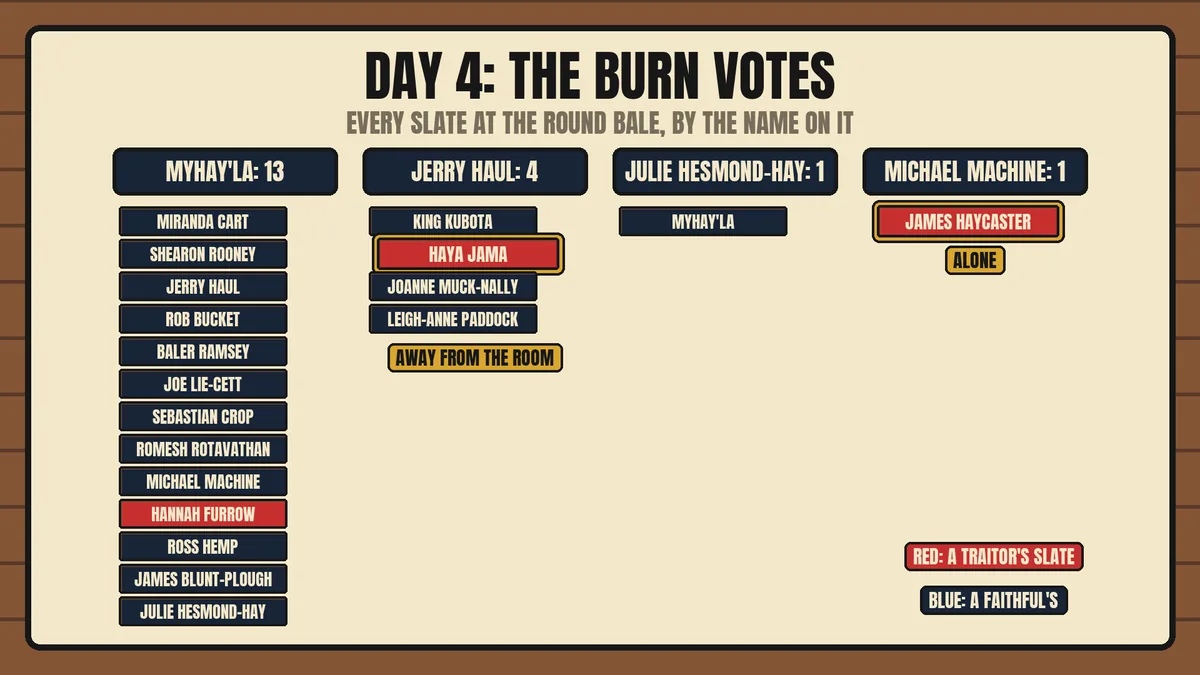
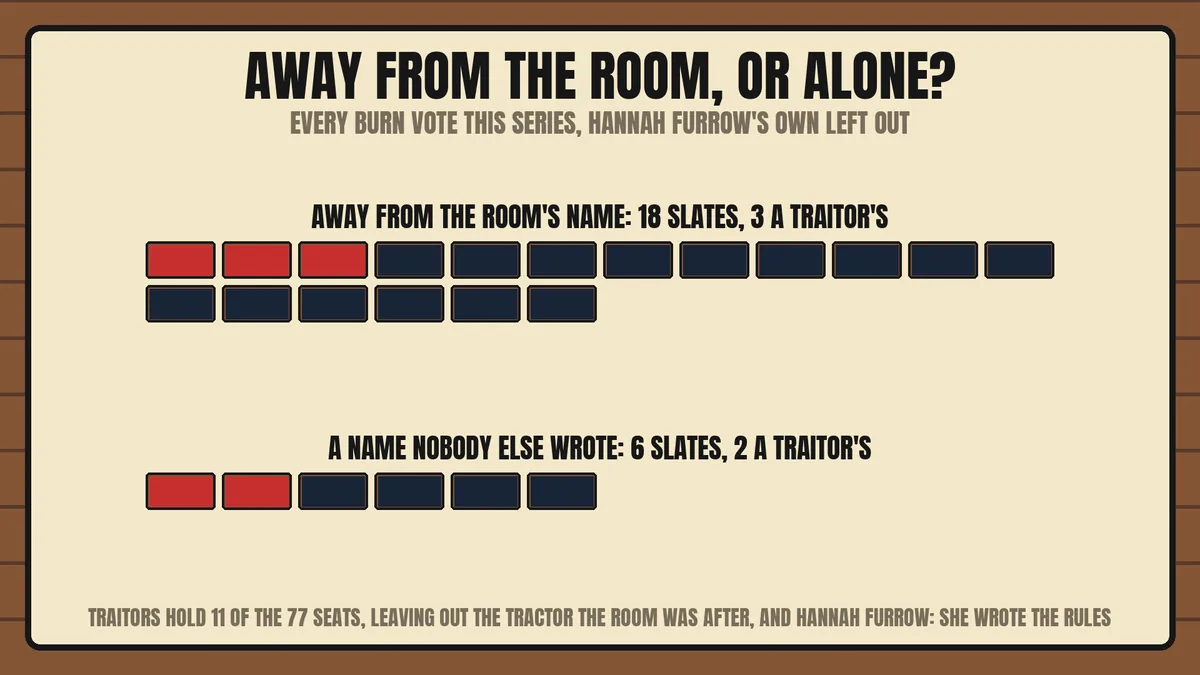
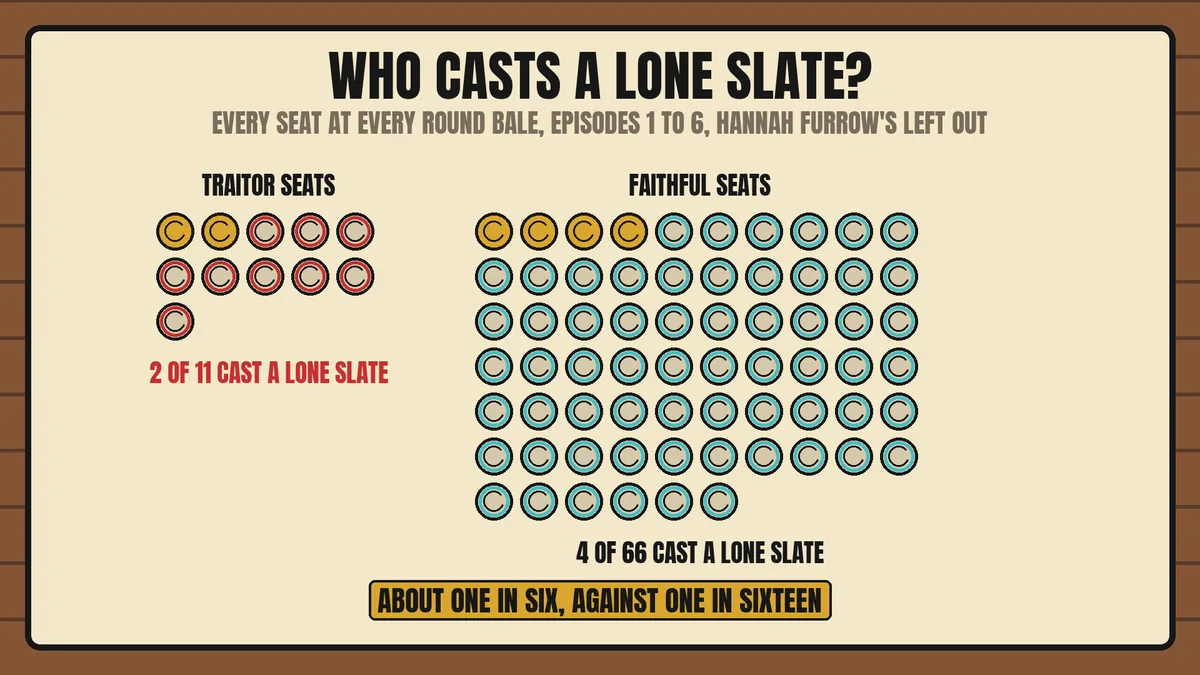
Read that way, the rule is weak. There have been 18 slates away from the room's main name this series, and 3 were a Traitor's: 17%, against a 14% baseline. Narrow it to a name nobody else wrote and it looks better: there have been 6 of those, and 2 were a Traitor's, 33%. But both are Haycaster's, on days 4 and 7. Scored Turing's way, a Traitor's seat has produced a lone slate about one time in six and a Faithful's about one time in sixteen, so a lone slate is about three times as likely to come from a Traitor. That is one tractor's habit, not yet a rule, and across the 14 earlier series a lone slate in the first three episodes is worth nothing either way. Hannah cast one too, for Jerry Haul on day 5; with her slates in, the counts were 4 of 19 and 3 of 7.
Hannah used the rule in the game, too. On day 6 she argued that James Blunt-Plough's earlier lone vote was what Traitors had done in previous series. He's a Faithful, and that lone vote had been for her.
Rule two: the pile-on
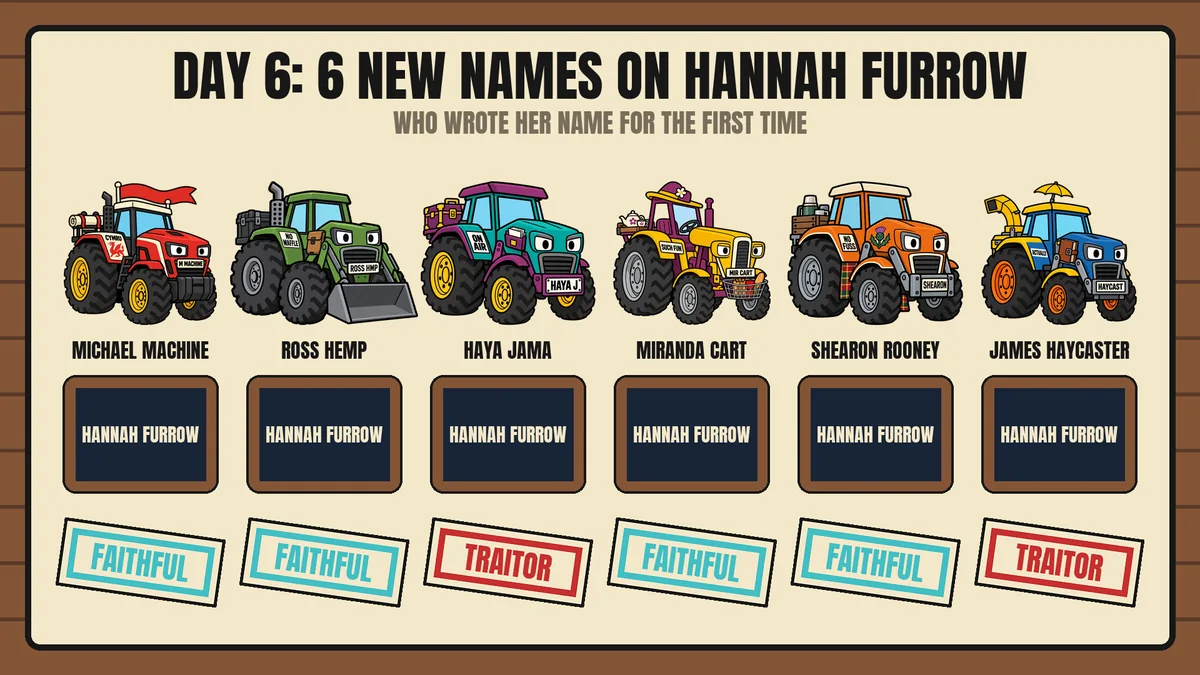
When a Traitor is going, Hannah said, the other Traitors pile on, though they've never written that name before. On day 6, six tractors wrote her name for the first time. Both Traitors were among them, and so were four of the twelve Faithfuls. The other eight Faithfuls didn't show it: seven had written her name at an earlier Round Bale, and one didn't write it at all. That is the point of her rule. A Traitor doesn't write a fellow Traitor's name until the end, and a suspicious Faithful often does it sooner.
The Traitors have kept to it. When the room turned on Richard on day 3 and on Hannah on day 6, the other Traitors wrote the same name every time, four slates out of four. Both were landslides, though, 16 slates of 20 and 12 of 15, so there was nobody to save.
Rule three: never three together
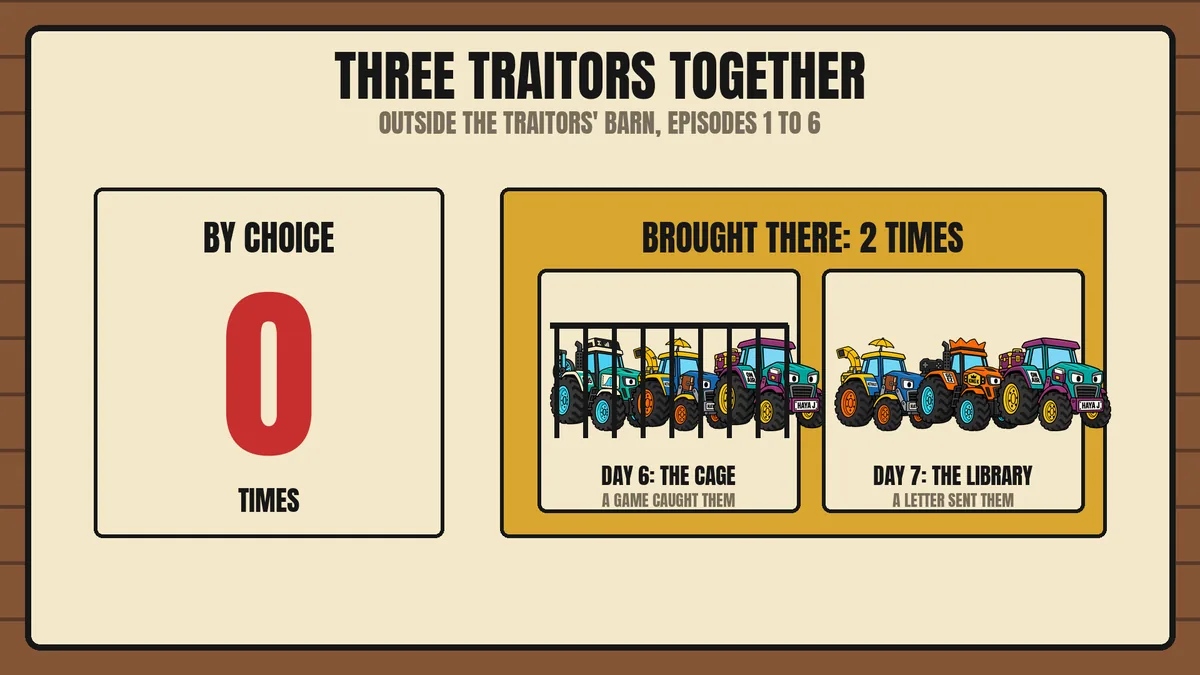
This was the one she called the big one. Traitors don't hang out together: never three in a car, never three side by side at breakfast. On day 7 all three sat in the library together, calling people in. The plain-sight murder letter sent them to the library for a bottle of sleeping powder, though it was Haycaster who picked the library as the room to do it in. The day before, a game had caught all three in the same cage. Outside the Traitors' Barn, we have never seen the three of them choose to be together. I can't test this rule properly, though, because the record says who was in a scene, not who sat next to whom.
The rules nobody says out loud
Those three are the rules Hannah stated. I went through all six episodes of Uncloaked, last year's traitorbot thesis on how the game is played around the world, and this series' own votes, and found many more. Most can't be tested on what the broadcast shows. Three were worth examining, and one of those couldn't be measured reliably.
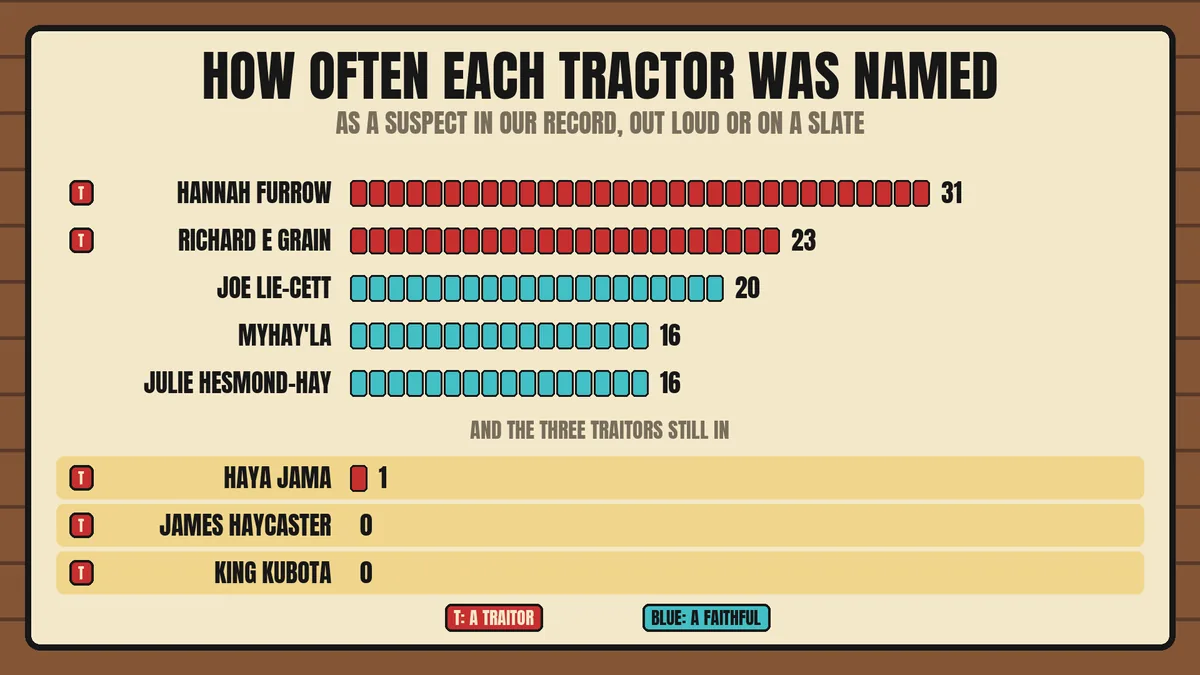
Nobody names them. Counting the suspicions in our record and every slate, Richard was named 23 times and Hannah 31. That count isn't exact: some slates are in the record twice, once as the vote and once as the tractor explaining it. Of the three Traitors still in, Haycaster has never been named, Kubota never, and Haya once. Some of that is survival, because a Traitor who gets named gets towed, and Kubota earned his zero as a Faithful. Three Faithfuls still in have never been named either: Miranda Cart, Romesh Rotavathan and Shearon Rooney. The Traitors recruit from the same quiet end: before they were recruited, Haycaster had never been named, Kubota never, and Hannah twice.
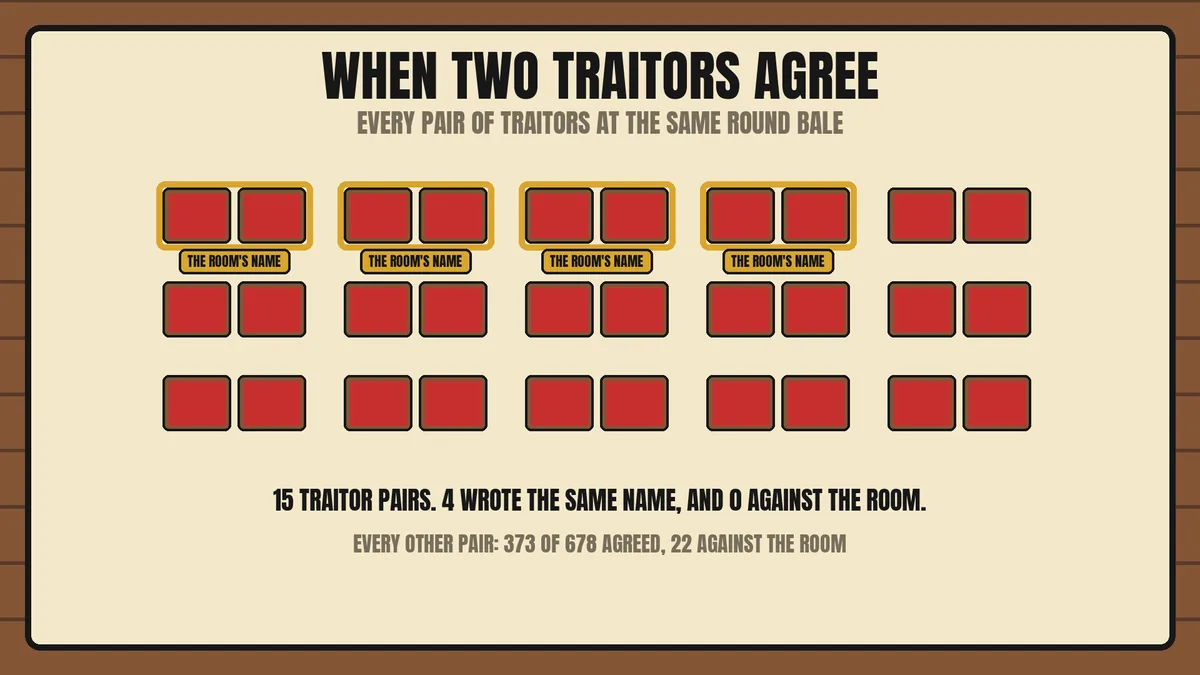
Two Traitors never gang up against the room. Pairs of Traitors at the same table have written the same name 4 times out of 15, and all four times it was the room's name. Other pairs agree 55% of the time, and now and then they agree against everyone else. With only 15 Traitor pairs, though, never agreeing against the room is about what chance would give. The clearer pattern is that Traitors spread their votes: they agree half as often as everyone else.
Traitors keep their story straight. Hannah said a good Traitor tells as much of the truth as possible and lies only when they have to. From the outside, that should look like a slate that matches what was said. I tried to measure it and couldn't do it reliably: too many of the remarks on record were said to camera rather than to anyone in the room, or were the slate itself being explained, and on others the record had the wrong speaker. So this one stays a theory for now.
The rules that catch Faithfuls
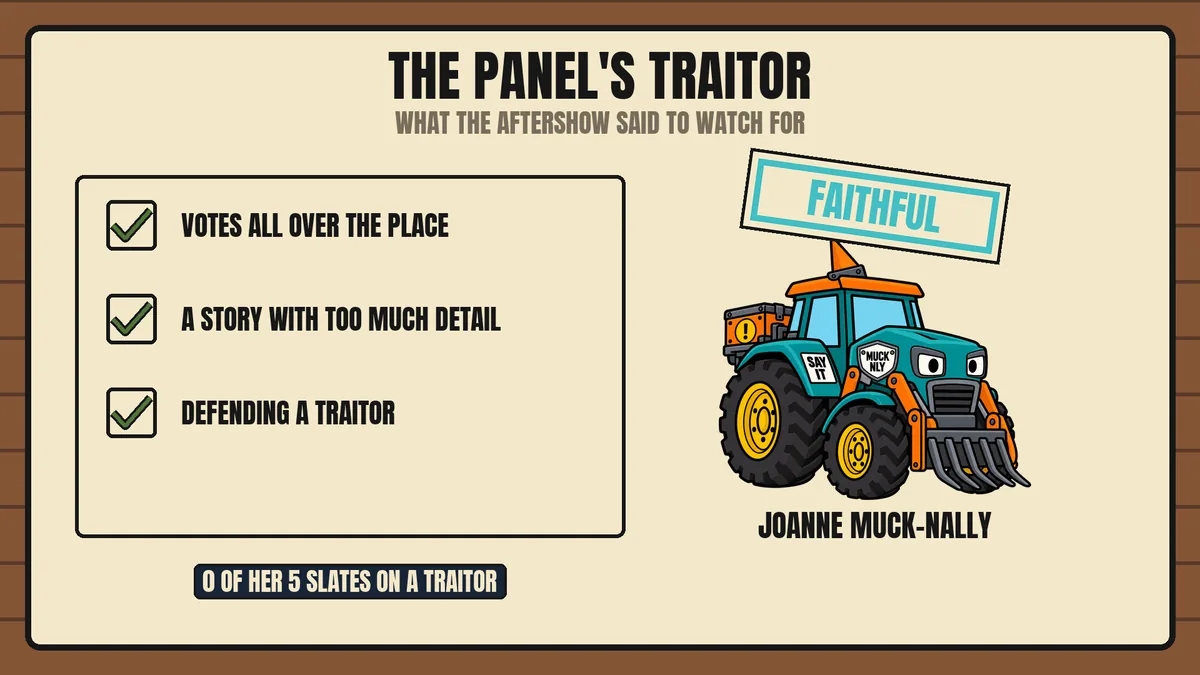
The Uncloaked panel, talking about Joanne Muck-Nally, said to watch for a vote all over the place, a story with too much detail, and anyone defending a Traitor. She's a Faithful who hasn't written a Traitor's name in five votes, so these are reasons to suspect someone, not signs of a Traitor. The panel's other test, that sticking to your guns is "Faithful behaviour", doesn't separate the sides either: the Traitors changed their vote in 2 of 3 chances, the Faithfuls in 9 of 14. And Joe Lie-cett, who spent a week asking to be recruited, went on 11 slates of 14 as a Faithful.
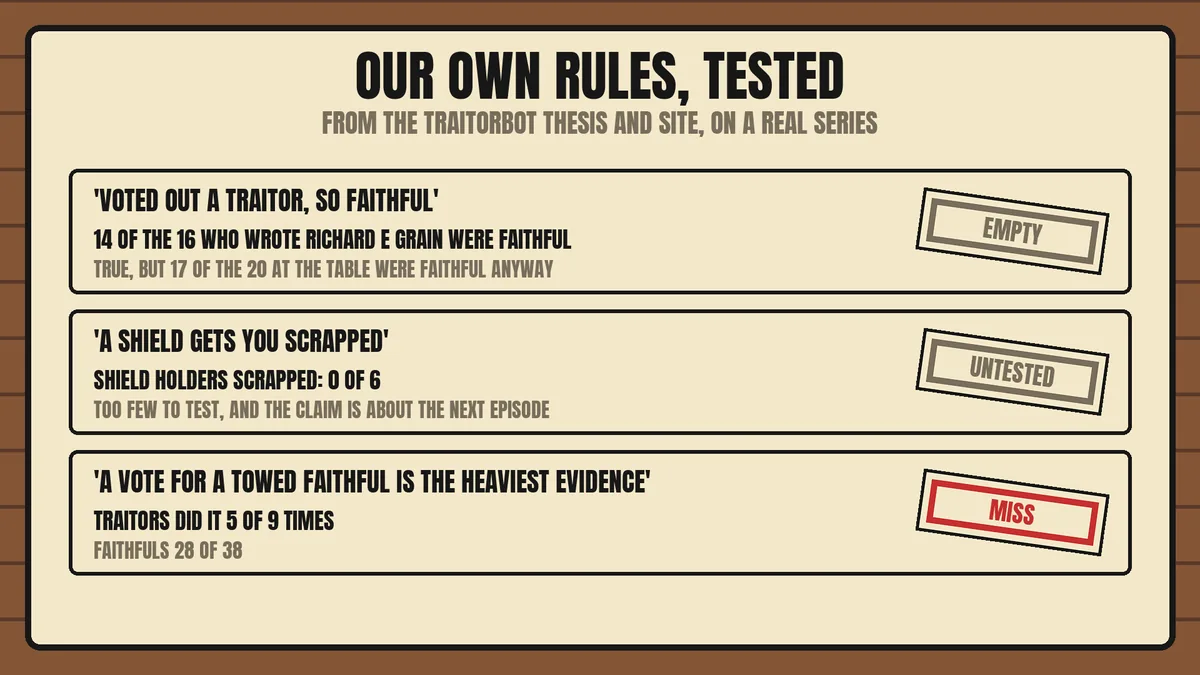
Three of the rules on trial are mine. The traitorbot site says a player who voted to banish a Traitor is 85% likely to be Faithful. On day 3, 14 of the 16 tractors who wrote Richard were Faithful, 87.5%, so the rule is true. It's also empty: 17 of the 20 at the table were Faithful anyway. The thesis treats a vote for a towed Faithful as the heaviest evidence there is, and here the Traitors did it less often than the Faithfuls. The site's Shield paradox says a Shield makes you a murder target in the next episode. None of the four Faithfuls who held a Shield was scrapped the next episode, which is too few to test it. Those figures came from a model and its simulations. This is the first time they've met a real series: one is true and tells you nothing, one can't be tested yet, and one misses.
The Combine's own Traitors
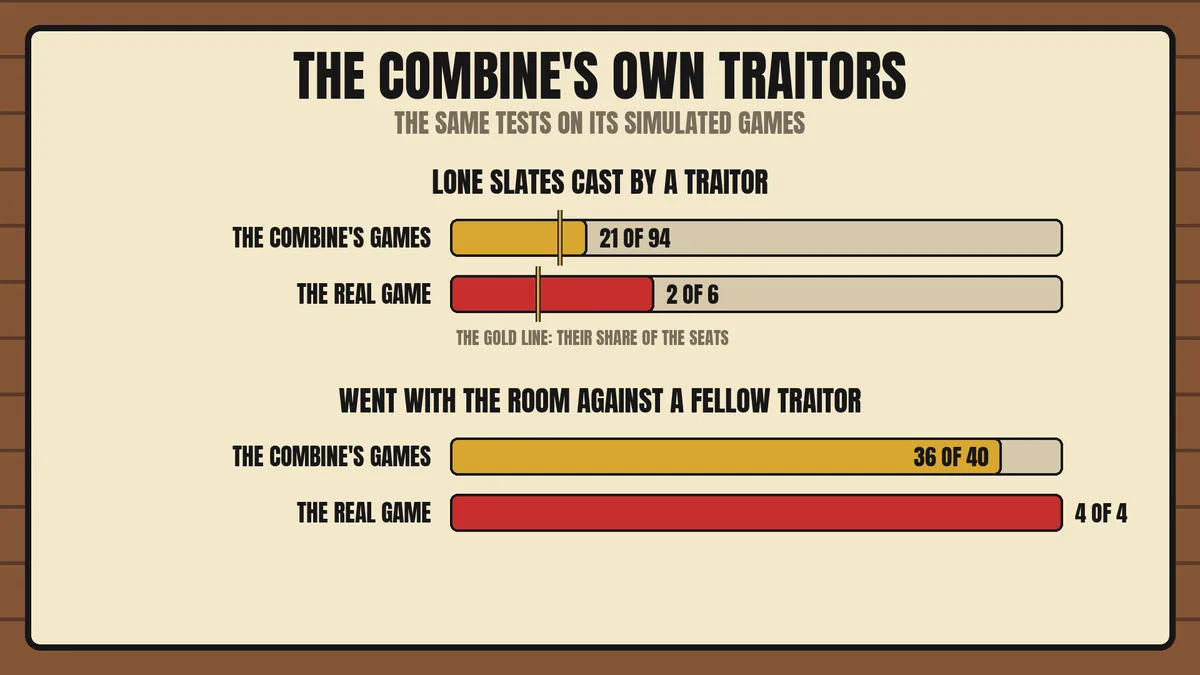
The Combine plays every episode twenty times, Traitors and all, so I ran the same tests on its games. Its Traitors give themselves away less on the lone vote: 21 of its 94 lone slates were a Traitor's, 22% against an 18% baseline, where the real Traitors manage 33% against 14%, Hannah's own left out. They keep the loyalty rule, though. When a fellow Traitor is going, a Combine Traitor writes that name 36 times out of 40.
Adding it up, Turing's way
So far each rule has been tested on this series alone, which is the series Hannah was playing. The fair test is the one her rules would have to pass anywhere. She learned them from the earlier series, so that is where their weights should come from, and this series is where they are applied, unchanged. I used only what every player can see, the slates, so a player who had learned these rules could apply them at the Round Table.
The method
Each clue gets a weight: how much likelier it is to come from a Traitor than from a Faithful. Written out, the weight is log10( P(clue | Traitor) ÷ P(clue | Faithful) ), measured in bans. A clue ten times likelier from a Traitor is worth one ban; one that is just as likely either way is worth nothing. Weights in bans add, which is why Turing worked in logarithms.
Two of Hannah's three rules can be read from the slates. Rule one, a burn vote in the first three episodes: a slate away from the table's most-written name, where the tractor the room was voting for gives no reading. Rule two, the pile-on: at a Traitor's banishment, writing that name having never written it before. Rule three, never three together, can't be read from a slate. Each player gives one reading per rule, since five slates from one player are one habit, not five clues, and each reading is labelled with the player's role at the time, so a recruit's earlier play counts as a Faithful's. I added a half to every count so that no clue is ever treated as certain. All of this was written down and frozen before any other series was scored.
Where the weights come from
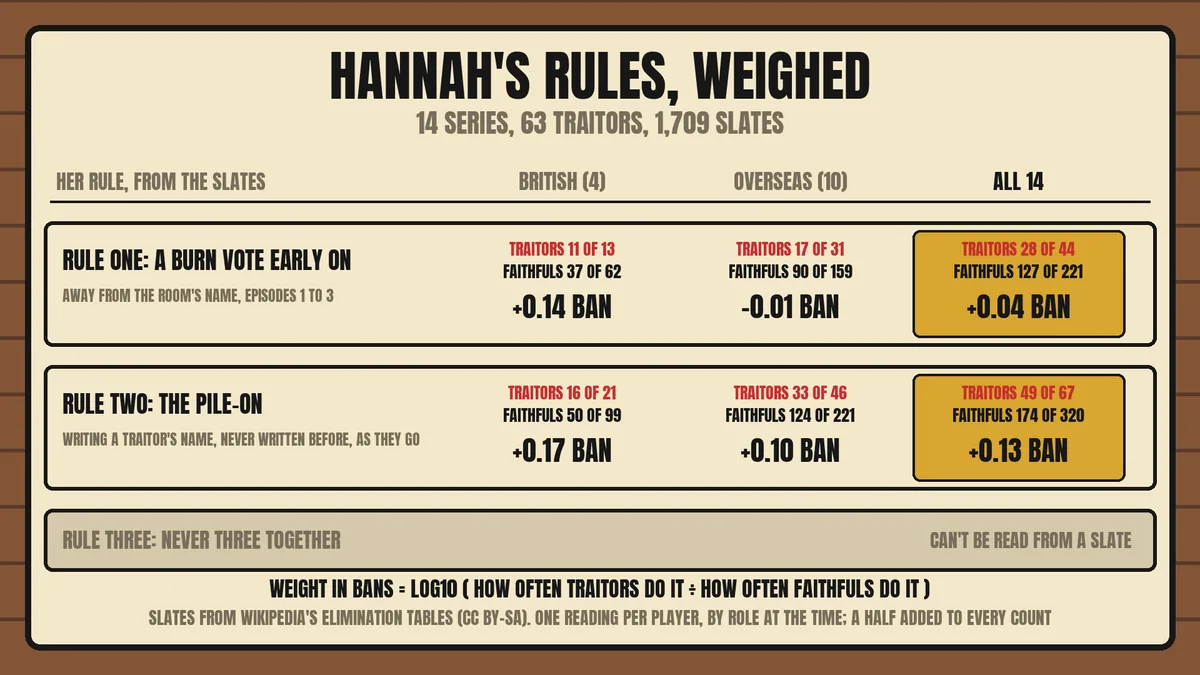
The votes for the other series come from Wikipedia's elimination tables, which record every slate at every Round Table. I gathered 21 series. 14 reproduce Wikipedia's own vote tally at every table, and those are the ones used: four British (series 1 to 3 and Celebrity series 1) and ten overseas (America 1 to 4, Australia 1 and 2, Canada 1 and 2, New Zealand 1 and India 1). That is 63 Traitors and 1,709 slates. The other seven each have a late Round Table that doesn't match the tally; kept in, both rules come out weaker.
| Hannah's rule | British (4 series) | Overseas (10) | All 14 (bans) |
|---|---|---|---|
| Rule one: a burn vote in the first three episodes | 11 of 13 Traitors, 37 of 62 Faithfuls: +0.14 | 17 of 31 Traitors, 90 of 159 Faithfuls: −0.01 | 28 of 44 Traitors, 127 of 221 Faithfuls: +0.04 |
| Rule two: the pile-on, never having written the name before | 16 of 21 Traitors, 50 of 99 Faithfuls: +0.17 | 33 of 46 Traitors, 124 of 221 Faithfuls: +0.10 | 49 of 67 Traitors, 174 of 320 Faithfuls: +0.13 |
Her pile-on is real everywhere, but small. Her burn vote shows up only in the British series, where it is worth about a seventh of a ban. Overseas it is worth nothing we can see.
How a ban value is set
Nobody picks these numbers. A weight is Turing's definition applied to the counts: the weight in bans is log10 of how often Traitors do it divided by how often Faithfuls do it. Take the pile-on. Across the 14 series, 49 of 67 Traitors did it (0.73) and 174 of 320 Faithfuls did it (0.54). The ratio is 1.34, and log10 of 1.34 is +0.13. That number falls out of the counts. The scale is Turing's: a clue ten times as likely from a Traitor is worth one whole ban.
A worked example: Haycaster
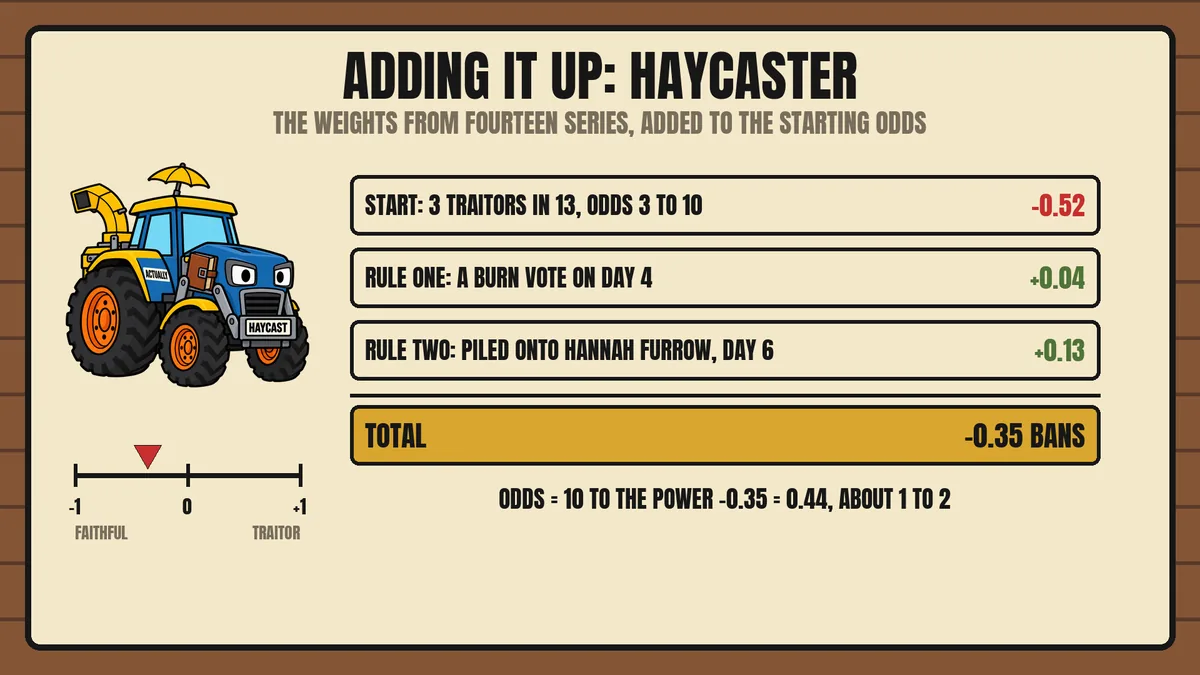
Every tractor starts from the same place. Three of the thirteen still in are Traitors, so before any clue the odds are 3 to 10, which is −0.52 bans. Haycaster's burn vote on day 4 adds +0.04, and piling onto Hannah on day 6, never having written her name before, adds +0.13. The total is −0.35 bans: odds of about 1 to 2, roughly a 31% chance. Her rules have moved him, but not far. He is still more likely a Faithful than a Traitor.
All thirteen
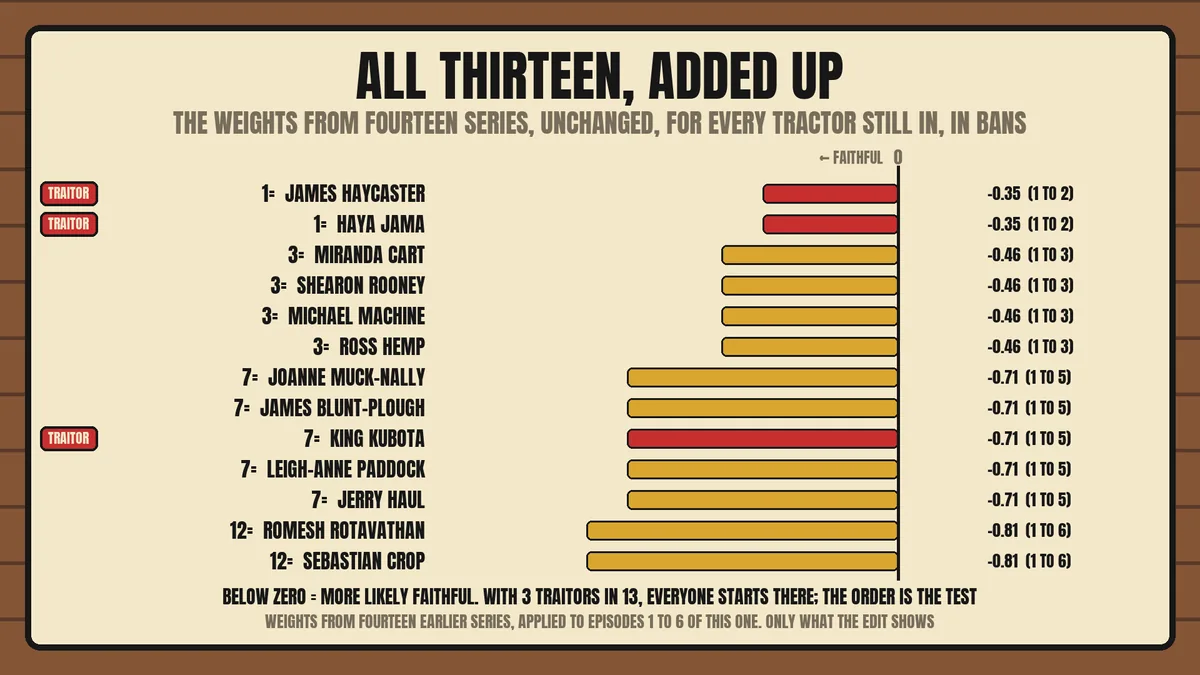
At the top, level, are Haycaster and Haya Jama, both Traitors, the only two still in who did both. A tenth of a ban behind them come four Faithfuls who piled on but cast no burn vote: Miranda Cart, Shearon Rooney, Michael Machine and Ross Hemp. Then come five tractors who cast a burn vote but didn't pile on, having written Hannah's name earlier or not at all: four Faithfuls, and King Kubota. Romesh Rotavathan and Sebastian Crop, who did neither, are last.
Why everyone is below zero
Everyone starts at −0.52 bans, because only 3 of the 13 are Traitors. Hannah's two clues are small: together they add at most +0.17, so nobody climbs past zero. That is the right answer, not a fault in the scale. With clues this weak, every individual tractor really is more likely Faithful than Traitor. A useful check is to turn each tractor's odds into a chance and add them up. They come to about 2.7 Traitors, close to the 3 there really are, so the scale is roughly honest. The test of the rules is the order, not the sign: do the Traitors rise to the top?
Why not rescale the bans?
Multiplying every weight by the same factor stretches everyone's score by the same amount, so the order never changes. Haycaster and Haya Jama stay on top, King Kubota stays among the Faithfuls, and the overseas check below stays at chance. It would only make the odds sound more confident. Picking the factor so the Traitors come out above zero would mean tuning the scale to the known answer, which is exactly what fixing the method in advance was meant to prevent. Fitted honestly, on the other series, the factor would come out below one, because there the rules barely rank Traitors above chance.
The Traitor her rules can't tell apart
King Kubota was recruited on night 6. Both his readings come from his time as a Faithful, a burn vote on day 4 and an earlier slate for Hannah. So to Hannah's rules he looks exactly like the four Faithfuls beside him. That is the weak spot in any rule that reads how people vote: a late recruit's record is a Faithful's until they start playing as a Traitor. After a recruitment night, what someone does from then on is the evidence that matters.
Would they have found them?
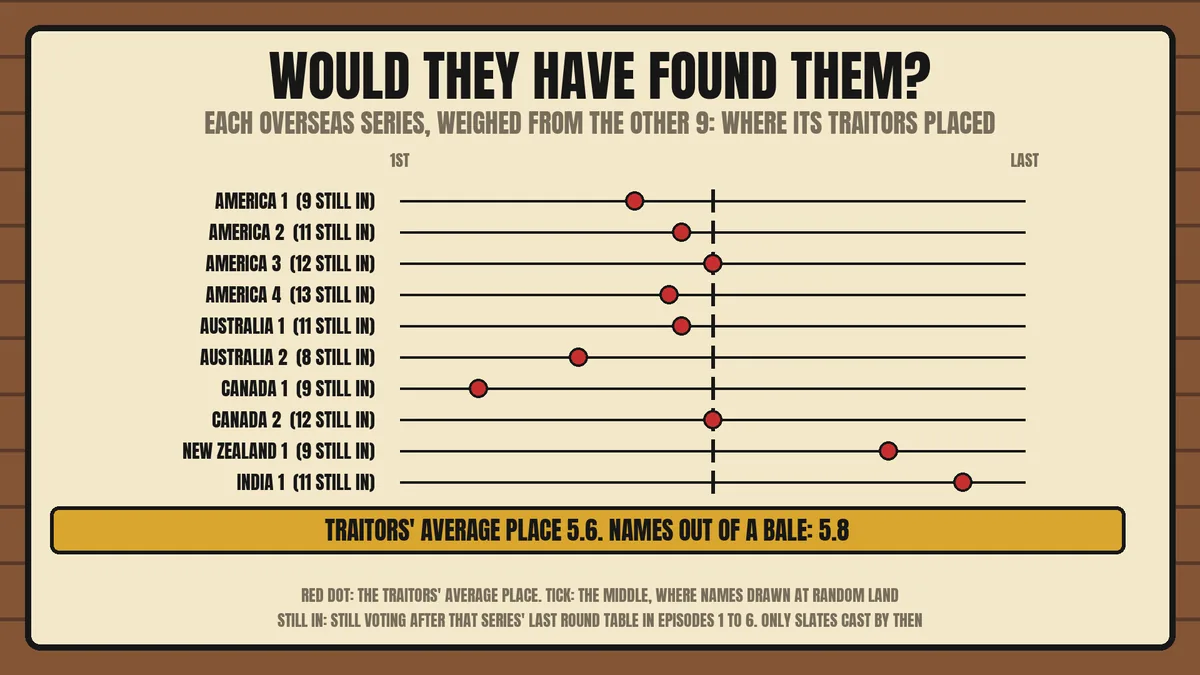
The fairest check left is to run the method on the series Hannah learned from, as if each were being played. I scored each of the ten overseas series with weights counted from the other nine, among the players still voting after its last Round Table in episodes 1 to 6, using only the slates cast by then. On average the Traitors placed 5.6; names drawn out of a bale would place 5.8. In Canada's first series her rules put the Traitors near the top, and in India's near the bottom. Over all ten, they find the Traitors about as often as chance.
How far to trust it
- Hannah studied all of these series, so the check above is within her own source material, not a fresh test. On this series she named Haycaster's and Haya Jama's burn votes herself, as a Traitor who knew who they were.
- Leaving her own slates out of rule one was decided after the first counts were made. It changes rule one's figures for this series, given above both ways, but not the weights or the verdict, which come from the other series.
- Wikipedia's tables record who wrote whose name, and nothing that was said. On this series we only see what the editors show us: a Traitor who changed their mind, or gave themselves away, off camera can't be counted.
- This is the ninth version of the sum. The earlier ones were weighed on this series alone, and two had counting errors. This one was fixed in writing before the other series were scored; one later amendment only renamed the two groups British and overseas, since she studied all of them.
- Her remark that a good Traitor tells as much of the truth as they can isn't in the sum. To test it you need to know who said what to whom, and the record isn't good enough.
So, does Hannah's theory work?
Not really. Weighed on fourteen of the series she learned from, with the method written down first, her pile-on is real everywhere but small, and her burn vote only shows up in the British series. On this series the two Traitors who did both come out on top, just, a tenth of a ban ahead of four Faithfuls, and King Kubota looks like a Faithful. Tested on the overseas series, her rules find the Traitors about as often as picking names out of a bale. She spotted something. It isn't much.
James Torque puts all of this to the test in a special before Episode 7: watch it on YouTube. Everything here is as of Episode 6, and I'll run it again after each episode, so the numbers will move. The Faithful don't need one perfect rule. They need to add up the small ones before the final.
Vote data for the other series: Wikipedia, the "Elimination history" tables of each series' article, licensed CC BY-SA 4.0.